10° clears most haze and low hills. Pick a lower value for a flat, clear horizon or a far northern location.
Hour by Hour Through Darkness
| Time | Galactic Core | Moon | Shoot |
|---|---|---|---|
Best Nights in the Next Six Weeks
Score 100 means at least three hours of core time in full darkness with no Moon. Moonlight lowers the score, a bright Moon most of all.
Average nightly core time in full darkness, ignoring the Moon.
When and Where to See the Milky Way Core
The Milky Way stretches all the way around the sky, but the part most photographers chase is the galactic core. This bright, dusty bulge sits toward the constellations Sagittarius and Scorpius, about 26,000 light years away.
Three things have to line up to photograph it well. The core has to be above the horizon, the sky has to be fully dark, and the Moon has to be out of the way. This planner checks all three for every night.
What Counts as Dark Enough
Astronomical darkness starts when the sun drops 18° below the horizon. Before that, a faint glow of twilight still lifts the sky background and hides the dimmer dust lanes.
Near the summer solstice, places above about 48.5° latitude never reach full darkness. You can still shoot the Milky Way there, but expect a brighter, bluer sky and less contrast.
The Moon matters even more. A thin crescent barely registers, but a half Moon or brighter washes out the faint parts of the Milky Way for as long as it is up. The score in this planner counts moon-free core time at full value and discounts time under a bright Moon.
Milky Way Season by Hemisphere
The core is behind the sun in December, so for a few weeks around then it is only up in daylight everywhere on Earth. As the year goes on, it rises earlier each night.
| Where you are | Season | Best months | How it looks |
|---|---|---|---|
| Mid northern latitudes (US, Europe) | February or March to September or October | May to August | Low over the southern horizon, rising before dawn early in the year and visible after dusk by late summer |
| Tropics | February to October | April to August | Higher in the sky with a longer season |
| Southern Hemisphere (Australia, New Zealand, Chile) | February to October | April to August | Climbs high overhead, sometimes passing almost straight up in winter |
Early in the season the core rises in the southeast a few hours before dawn. By midsummer in the north it is already up at dusk and arcs across the south. Late in the season it shows briefly in the southwest after dark and then sets.
Latitude sets the ceiling. The core's highest point is roughly 61° minus your latitude in the Northern Hemisphere, so it peaks near 26° from Arizona and under 10° from London. North of about 51° it never clears 10°, which is why the planner lets you lower the minimum height.
Camera Settings for the Milky Way
Start with these settings on a full frame camera and adjust from there.
- Use a wide lens from 14mm to 24mm, as fast as you have (f/1.8 to f/2.8).
- Shoot wide open, or one stop down if the corners look soft.
- Set the longest shutter speed your focal length allows before stars trail, usually 10 to 25 seconds.
- Start at ISO 1600 to 6400, depending on your camera and how dark the site is.
- Focus manually on a bright star using magnified live view.
- Set white balance around 3800K to 4200K, or shoot RAW and set it later.
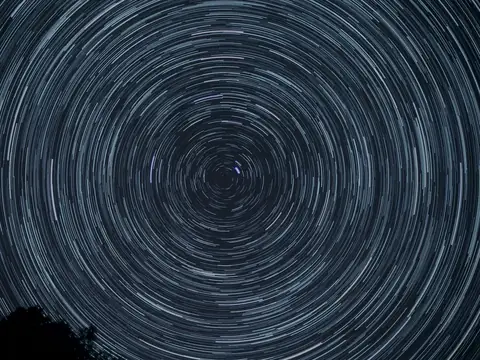
The star trails calculator works out your exact shutter speed with the NPF rule and the 500 rule, based on your sensor, lens, and aperture.
Get to your spot before the window opens. Use the core's direction from the planner to find your composition in daylight, and check it against the terrain with the sun position planner map.