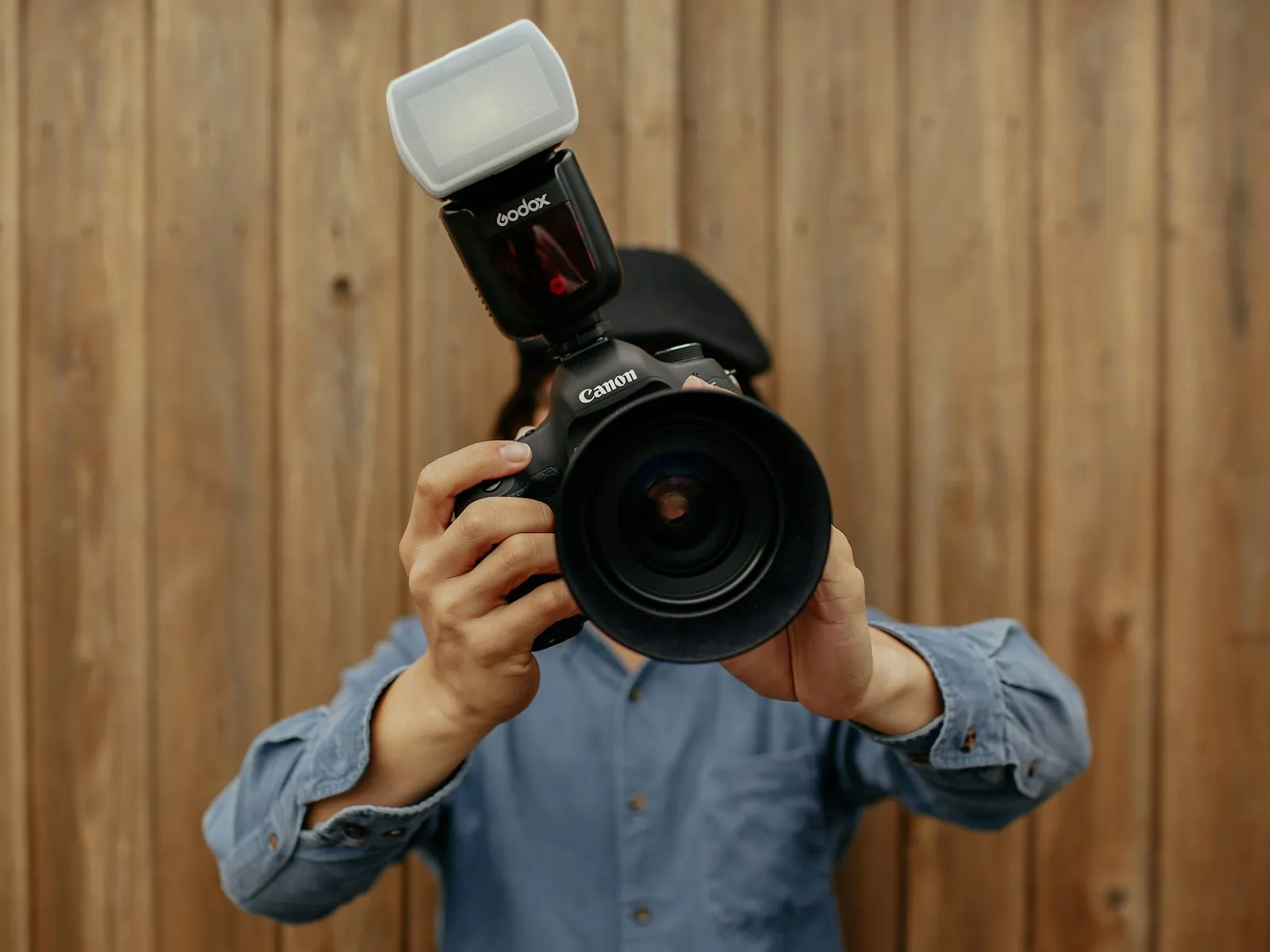
Every flash modifier ever made does exactly one thing. It makes your flash bigger. A softbox, an umbrella, a diffusion panel, a bedsheet taped to a doorframe, all of them take the tiny, harsh source on your camera and spread its light across a larger area so it turns soft.
That's the whole secret. Once you know it, modifier shopping stops being confusing. You're not choosing between mysterious tools. You're choosing how big you want your light to be, how much control you want over where it goes, and how much you want to spend.
This guide covers the main modifier families and which one to buy first, rounding out the gear side of the flash photography guide. Everything here leans on the most important idea in all of lighting, the size rule explained in hard light vs soft light.
The Size Rule Governs Everything
The apparent size of a light source relative to your subject determines whether its light is hard or soft. Not the brand, not the price. Size, relative to the subject, as seen from the subject's position.
A small source sends light rays from essentially one direction, so shadow edges come out razor sharp. Think of the shadow your hand casts in direct sunlight. A large source sends rays from many directions at once, and those overlapping rays fill in each other's shadows, so edges turn gradual and soft.
Two words in that rule matter more than people expect.
Relative. A 24-inch softbox is huge compared to a face and tiny compared to a car. There is no such thing as a soft modifier, only a soft combination of modifier, subject, and distance.
Apparent. Distance shrinks everything. That 24-inch softbox 2 feet from a face is a wall of light. Move it 20 feet away and it's a bright dot again, and the light goes right back to hard.
A window makes beautiful portrait light for exactly this reason. It's a big source near the subject. Every modifier you can buy is an attempt to recreate a window on demand, anywhere, at any power.
What Bare Flash Actually Looks Like
A bare speedlight has a flash tube roughly the size of your thumb. From 6 feet away, its apparent size roughly matches the midday sun, the textbook hard source. The light it produces is correspondingly brutal.
Shadows with razor edges. A hard black outline of your subject on the nearest wall, every time.
Flat, frontal illumination. On-camera flash sits an inch above your lens and fires straight ahead, filling in every shadow you'd normally use to show shape. Faces lose dimension and look like passport photos.
Hot, glaring highlights. Small sources create small, intense reflections. Shiny foreheads and white rectangles in eyeglasses.
A dark cave behind the subject. Flash falls off fast with distance, so the subject exposes correctly while the room behind them drops toward black.
If that list describes your photos, the full diagnosis lives in why your flash photos look harsh. Every modifier in this article exists to fix these problems, and they all do it the same way, by making the source bigger.
Shoot-Through Umbrellas
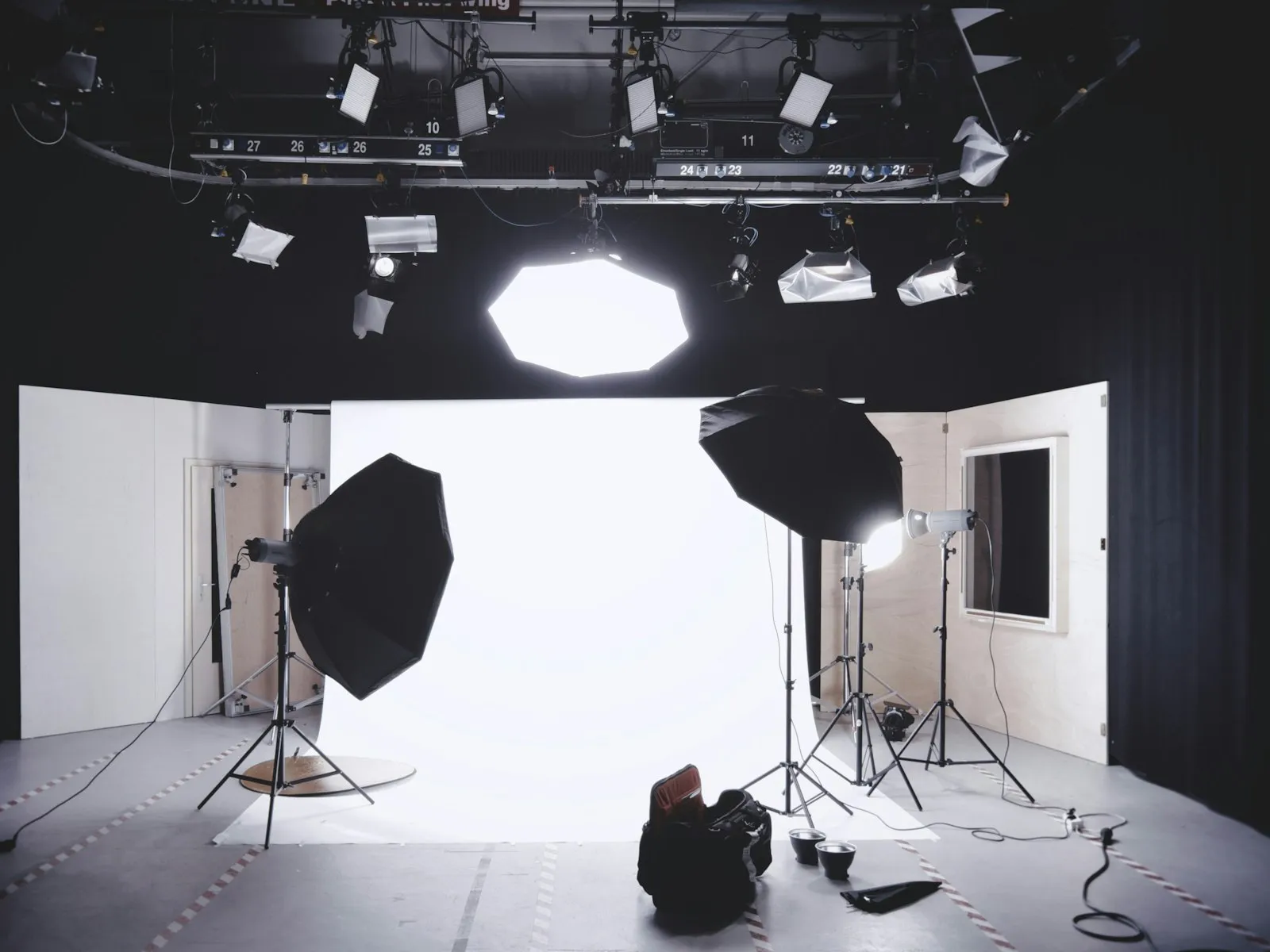
A shoot-through umbrella is a white translucent umbrella you fire the flash through. The flash hits the fabric, the fabric scatters the light, and the whole canopy becomes your new source. A thumb-sized flash tube just became a 40-inch light.
Setup: Mount the flash and umbrella on a stand with a tilting bracket, point the umbrella's tip at your subject, and fire through the fabric.
Result: Very soft, very forgiving light with round catchlights in the eyes. For the money, nothing else comes close. A usable shoot-through umbrella costs about as much as a pizza dinner.
Best for: A first modifier, single-person portraits, and anyone who wants maximum softness per dollar.
The catch: Spill. An umbrella sprays light everywhere. Out the back, past the edges, all over the room. In a small white room that spill bounces around and acts as free fill, which can genuinely help. When you want a dark background, moody contrast, or any precision at all, the spill fights you.
Reflective Umbrellas
A reflective umbrella flips the arrangement. The inside of the canopy is coated white or silver, the outside is backed with black fabric, and you fire the flash into the bowl so the light bounces back out at the subject.
Setup: Same stand and bracket as a shoot-through, but the umbrella opens toward the subject and the flash fires away from them, into the canopy.
Result: Soft light with noticeably more control. The black backing stops light from spraying behind the umbrella, so roughly half the spill problem disappears, and less light is wasted passing through fabric. White interiors stay soft and neutral. Silver interiors are punchier, with crisper highlights and a little more output.
Best for: Anyone who liked their shoot-through but got tired of light bouncing off every wall in the room.
The catch: It's still an umbrella. The edges still leak, and you can't shape or flag the beam with any precision. Many cheap umbrellas are convertible, with a removable black cover that turns a shoot-through into a reflective, the best of both for a few dollars more.
Softboxes
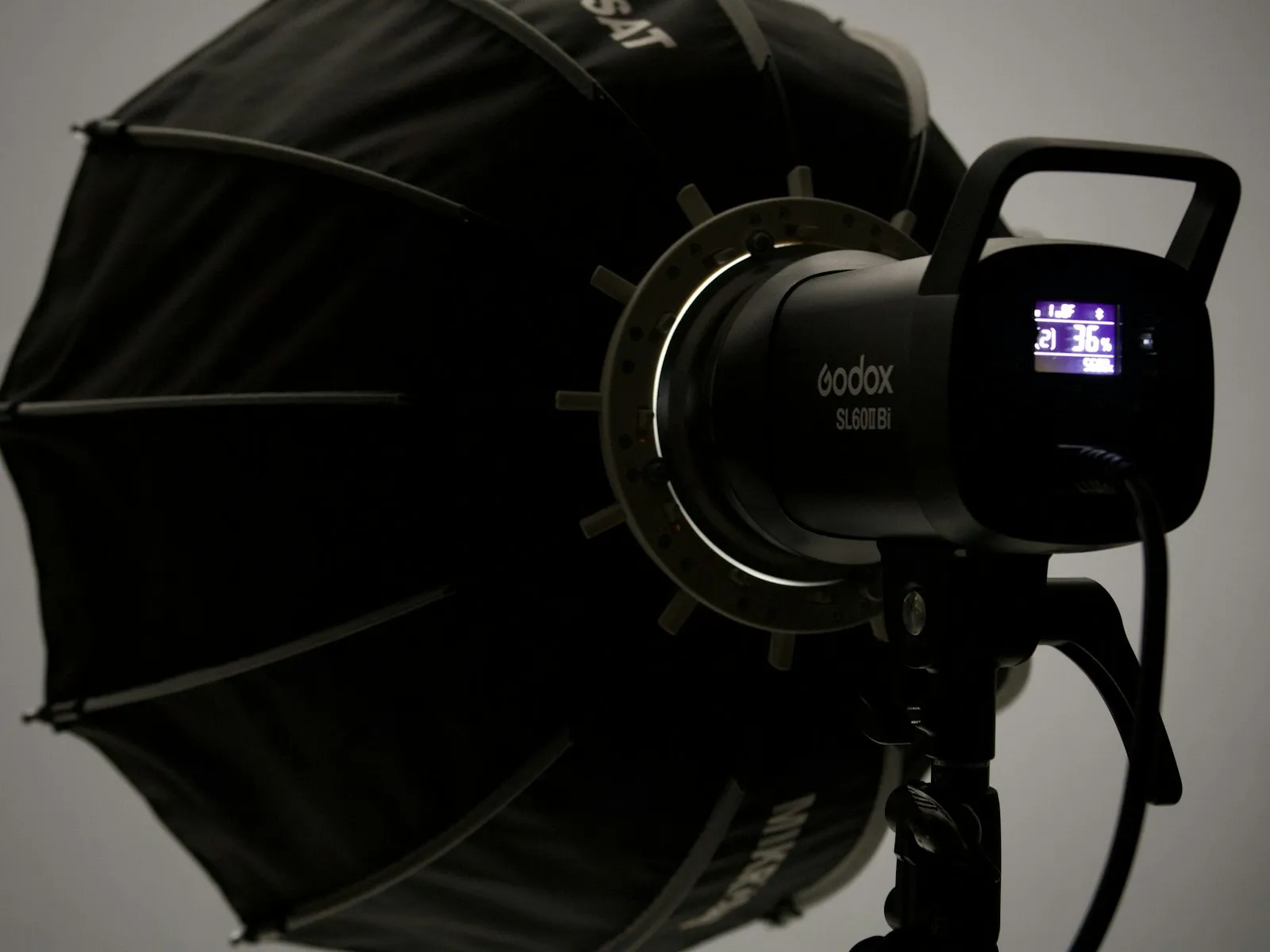
A softbox is an enclosed fabric box. Reflective silver interior, black exterior, and a white diffusion panel stretched across the front, usually with a second inner baffle to even out the hot spot. The flash fires into the box, and the only way out is through that front panel.
The enclosure is the entire point. It buys you three things no umbrella can deliver.
Containment. Light exits the front and nowhere else. The background stays as dark or as bright as you decide, not as the spill decides.
Direction. A softbox is a soft source you can aim like a hard one. Point it at your subject, and that's where the light goes.
An edge. Softbox light has a defined boundary, and you can feather that edge across a subject, lighting a face brightly while the light falls away gently across the shoulders and body. Umbrella light has no usable edge to work with.
This is why the softbox is the workhorse of portrait lighting. It delivers window-quality softness with studio-grade control, and the rectangular catchlights it leaves in eyes look like, fittingly, windows.
Sizes and shapes. A useful rule of thumb is to match the modifier roughly to the subject. A 24 to 32 inch box suits a head-and-shoulders portrait. Bigger boxes cover full bodies, strip boxes make rim and hair lights, octaboxes give rounder catchlights. Add a fabric grid to the front and the beam tightens further, producing soft light that touches your subject and nothing else.
The catch: Cost and setup time. A decent softbox costs several times what an umbrella does, takes longer to assemble, and packs down bigger. You're paying for control, not for extra softness. An umbrella the same size is just as soft.
Small Diffusers and Dome Caps
Now for the honest part. The little plastic dome that shipped with your flash, the pop-on cap, the palm-sized "mini softbox" that velcros over the head of whatever sits in your hot shoe. Do they work?
Indoors, a little. Outdoors, barely at all.
Run the size rule on them. A 2-inch dome over a 1-inch flash tube is still a tiny apparent source from 6 feet away. It cannot meaningfully soften light on its own, and no clever shape of translucent plastic changes that physics.
What a dome actually does indoors is scatter light in every direction, up into the ceiling and sideways into the walls. Those big white surfaces light up and become large secondary sources, and the room itself softens your light. That genuinely helps. But notice what's doing the softening. It's the ceiling, not the dome. You can get a stronger version of the same effect for free by tilting the flash head and learning proper bounce flash technique.
Outdoors, there is no ceiling and there are no walls. The scattered light flies off into the sky and never comes back, and the dome simply eats a stop or more of power while the light on your subject stays just as hard. Take it off outdoors. Save the battery for the job flash actually does out there, which is fill flash.
What Modifiers Cost You in Power
Every layer of fabric between flash and subject absorbs light. A shoot-through umbrella costs around a stop. A double-baffled softbox costs around two stops.
Flash power is set in fractions, full power, then 1/2, 1/4, 1/8, and so on, and each halving is exactly one stop less light. So if you metered a scene at 1/8 power with a bare flash, the same exposure through a two-stop softbox needs 1/2 power. You'll hit full power sooner than you expect, and recycle times stretch as you climb.
A bare flash's reach is described by its guide number, which is simply distance multiplied by f-number at ISO 100. A guide number of 40 in meters means f/4 at 10 meters. The moment you add a modifier, the published number stops applying, partly because of fabric losses and partly because the light is now spread across a much larger area.
There's good news hiding in the physics, though. Soft light wants the modifier close, and flash output follows the inverse square law. Double the distance and the light drops to a quarter, two full stops. Halve the distance and you gain those two stops back. The same move that makes your umbrella softer, bringing it in tight, also recovers most of the power the fabric ate. Working close solves both problems at once.
To see how power, distance, and aperture trade against each other, how flash exposure works walks through the logic, and the guide number calculator does the arithmetic for you.
Reflectors Are the Free Second Light
A reflector isn't a modifier in the strict sense, since it never touches the flash, but no modifier discussion is complete without one.
Bounce your softened key light off a white surface on the far side of the subject and the shadows lift. That's fill light without a second flash, a second stand, or a second anything. A sheet of white foam core does the job. So does a collapsible 5-in-1 reflector, a white wall, or a patient friend holding a bedsheet.
Control is physical. Move the reflector closer and the shadows brighten. Pull it back and they deepen. You watch the change in real time, no test shots required.
For a one-flash photographer, a reflector is the difference between flat, one-sided lighting and a proper ratio between the lit and shadow sides of a face. Buy one before you think about a second flash.
Choosing Your First Modifier
Here's a growth path that doesn't waste money.
-
Start with zero dollars. Learn to bounce off ceilings and walls first. It teaches light direction and source size before you spend anything.
-
Buy a convertible umbrella. Add a cheap stand, a tilting bracket, and a trigger, the same starter kit covered in getting started with off-camera flash. The whole package costs less than a decent tripod, and the umbrella alone delivers most of the softness a softbox ever will.
-
Add a white reflector. Foam core from an art store is fine. This is your second light, free forever.
-
Buy a 24 to 32 inch softbox when spill starts to bother you. You'll know the moment, because you'll keep noticing backgrounds you can't darken and contrast you can't control. That frustration is the signal you've outgrown umbrellas.
-
Specialize later. Grids, strip boxes, octaboxes, and beauty dishes all solve narrower problems. Wait until you can name the specific problem before buying the specific tool.
The umbrella teaches you everything that matters. Softness comes from size, size is relative, distance changes both, and control is what you actually pay for. Once those ideas are in your hands, every modifier in every catalog is just a different way of making a small light big.
Key Takeaways
- Make your flash bigger relative to the subject and the light gets softer; every modifier that exists works on this one principle.
- Buy a shoot-through or convertible umbrella first because it delivers most of a softbox's softness for a fraction of the price.
- Choose a softbox when you need control, since its enclosed design stops spill and gives the light a defined edge.
- Skip the small dome diffuser outdoors; with no walls or ceiling to spread light into, it mostly eats flash power.
More in This Guide
Continue building your flash skills.